


In rural Bangladesh, thousands of women struggle every day to support their families without a stable income, savings or access to economic opportunities. For women who are widowed, divorced, abandoned or living with husbands unable to work, earning a livelihood can be particularly difficult. Many depend on irregular daily labour, often with little opportunity to develop skills, build assets or secure their families' future.
Despite Bangladesh's progress in reducing poverty, economic vulnerability remains a serious concern, particularly in rural communities. According to the Bangladesh Bureau of Statistics (BBS) Household Income and Expenditure Survey 2022, 20.5 percent of the rural population lived below the poverty line, compared with 14.7 percent in urban areas. Extreme poverty affected 6.5 percent of rural residents. The survey also found that 19.1 percent of households headed by widowed or divorced individuals lived below the poverty line nationally.
Behind these statistics are women who have the ability and determination to work but lack the resources and opportunities to become financially independent. Climate-related disasters, limited employment opportunities and restricted access to financial services can make their situation even more difficult.
For Bangladesh, supporting these women is not only about reducing poverty. It is also about enabling a section of the population that has long remained economically marginalised to participate more fully in the country's development.
This is where initiatives such as Strengthening Women's Ability for Productive New Opportunities (SWAPNO) have an important role to play.
Launched in 2014 by the Government of Bangladesh and the United Nations Development Programme (UNDP), SWAPNO with support from Sweden and Marico, was designed to help extremely poor rural women build sustainable livelihoods through temporary employment, savings, skills development, financial inclusion and access to longer-term earning opportunities.
The initiative began in poverty- and disaster-prone districts, including Kurigram and Satkhira, before expanding to other areas. Its first phase supported 12,492 households and provided women with opportunities to move beyond irregular employment. Through digital financial services, all women participating in the first phase gained access to formal financial institutions, while 588 women secured jobs in the ready-made garments and leather sectors.
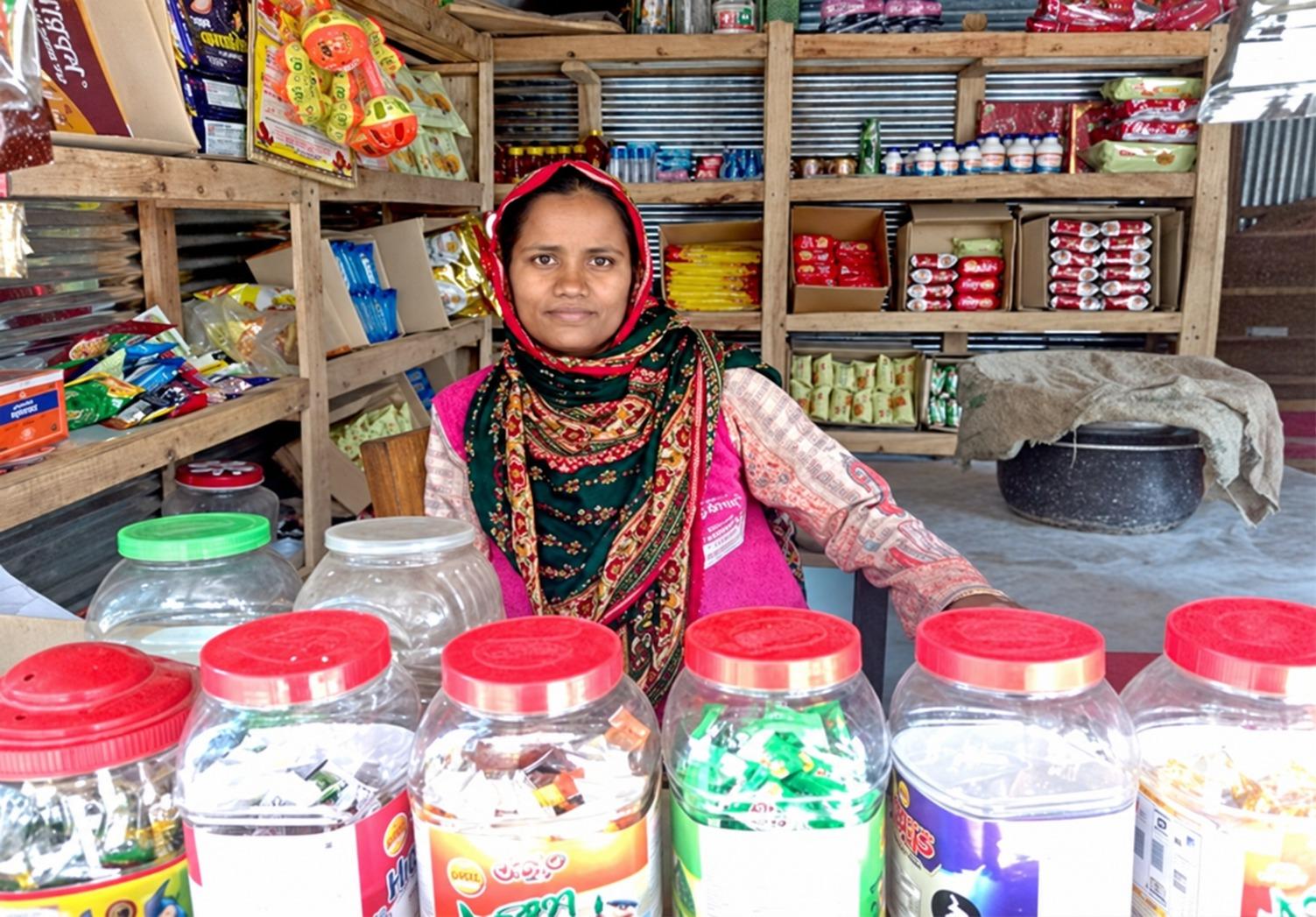
Building on these achievements, SWAPNO-II has extended support to 10,188 ultra-poor and climate-vulnerable women across 12 districts, covering 283 union parishads and 32 upazilas. Implemented by the Local Government Division with technical support from UNDP and support from the Embassy of Sweden in Dhaka and Marico, the second phase places greater emphasis on entrepreneurship, diversified livelihoods, apprenticeships, digital tools, and climate resilience.
But the importance of SWAPNO becomes clearer through the experiences of the women themselves.
For Nargis Begum, a mother of two from Jummapara village in Nilphamari, life had long been a struggle to make ends meet. After losing two husbands, she had no reliable income to support her children and depended on whatever work she could find.
Her circumstances began to change in May 2024 when she joined SWAPNO-II.
Initially, Nargis earned BDT 250 a day through public asset maintenance work. Through the project's rotating savings mechanism, she began putting aside part of her wages and gradually invested in income-generating activities. She bought a goat, leased land to cultivate rice, and later received BDT 40,000 (USD 325) in grant support to expand her grocery business.
Alongside financial assistance, she received training in financial management, women's rights, nutrition, telemedicine, and disaster preparedness.
Today, Nargis is planning to expand her business and provide greater financial security for her children. The opportunity to earn and save has helped her move from managing daily hardship towards planning for the future.
For Nilufa Yasmin, another SWAPNO-II participant, the challenge was different but equally difficult. After a road accident left her husband unable to work, Nilufa became responsible for meeting her family's expenses, including medical treatment. Joining SWAPNO-II provided her with regular employment, but she knew the work would last only 12 months.
Determined to secure an income beyond that period, she saved part of her wages and started a small grocery shop from her home.
With entrepreneurship training, she learned about investment, basic accounting, and business management. She gradually expanded her business, introducing traditional steamed cakes during winter and supplying mosquito coils to nearby shops.
Today, her shop records daily sales of around BDT 1,400–1,500 (USD 11–12). More importantly, she has created an earning opportunity for another SWAPNO participant.
Their experiences show why temporary employment alone cannot address long-term poverty, particularly in climate-vulnerable communities where floods and other disasters threaten livelihoods. By combining employment with savings, skills development and access to finance, SWAPNO helps women build sustainable sources of income.
Over the past decade, SWAPNO has evolved from providing temporary employment to supporting long-term economic independence. Expanding this approach to more vulnerable communities would help marginalised women develop alternative livelihoods and strengthen their financial resilience.
For Nargis, this means expanding her business and securing her children's future. For Nilufa, it means running a business that also creates an earning opportunity for another woman. Their journeys demonstrate how investing in marginalised women can create lasting benefits for families and communities, making the expansion of SWAPNO increasingly important for Bangladesh's inclusive development.


